Part I: European Drone Sensor Supply Gaps: Where Tier-1 and Tier-2 Suppliers Can Enter
Part I: IR detector bottlenecks, EO second-sourcing and design-in opportunities

In our previous analysis we looked at why Tier-1 suppliers should integrate directly with unmanned-system OEMs rather than wait for conventional program structures. The value of these integrations lies in operational validation, production learning and the reference position created through sustained deployment.
This article begins a three-part series on the sensing layer of European unmanned systems: the infrared, image, radar, RF, acoustic, inertial and related technologies that sit underneath cameras, seekers, navigation systems and counter-UAS architectures.
The question throughout the series is: Where is the sensing requirement important enough, and incumbent supply weak enough for an OEM or integrator to qualify a new supplier?
That question is becoming more relevant as unmanned systems move towards higher production volumes and more demanding battlefield roles. Ukrainian OEMs continue to adapt platforms rapidly around operational requirements, but increasingly need higher-performance components, scalable production and alternatives to critical Chinese supply.
For European Tier-1 and Tier-2 component suppliers, the opportunity is to identify where Ukrainian OEMs need higher-performance, scalable or non-Chinese alternatives and secure a design-in position as those platforms evolve.
Procurement policy reinforces this shift. European funding, localisation requirements and new procurement mechanisms are putting greater weight on component origin and supply-chain resilience. But these measures matter most where there is already a real industrial problem: insufficient capacity, excessive dependency, unsuitable economics or a sensing requirement that existing suppliers cannot meet. Sensors show where these pressures become actionable at component level.
In this first part, we focus on infrared detectors and EO (electro-optical) image sensors. Both markets face supply-chain pressure, but for different reasons. In infrared, the immediate constraint is increasingly production capacity and detector availability. In daytime EO, the opportunity is more about industrialising existing European capabilities at the cost and volumes required by unmanned systems.
Infrared Detectors for Drones: A Real European Supply Bottleneck
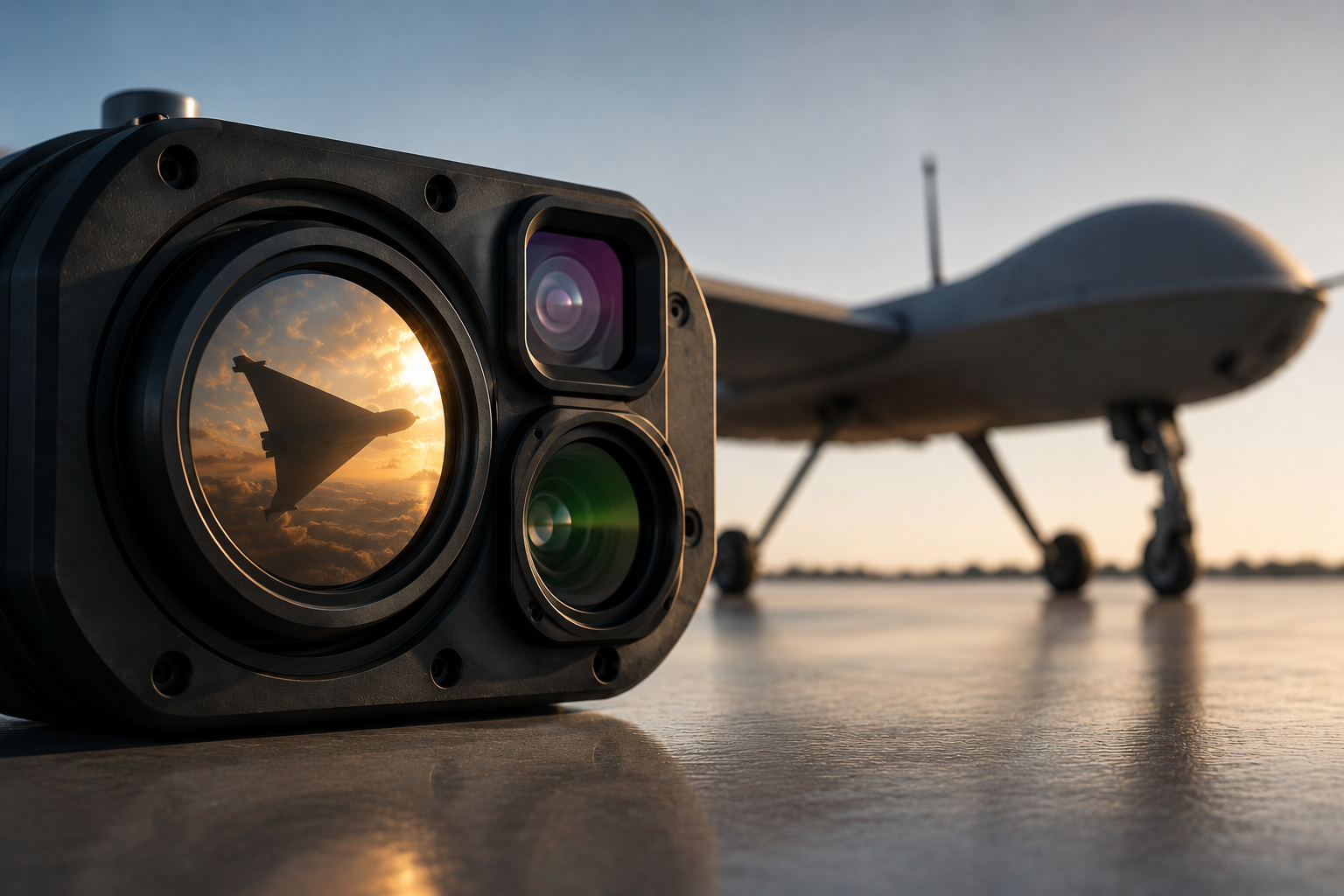
Night FPVs, reconnaissance systems, and interceptor drones are creating demand for increasingly large numbers of compact thermal cameras. A detector developed around traditional aerospace volumes may meet the technical requirement and still fail the commercial requirement for an interceptor or low-cost tactical UAS. That demand translates into requirements for uncooled infrared detectors, particularly microbolometers, at the unit cost and production volumes required by unmanned systems designed for high-rate manufacture.
An analysis by the IRON Cluster and Snake Island Institute, reported by Militarnyi, estimated Ukrainian localisation of thermal-imaging cameras at no more than approximately 25%. The dependency becomes more significant further upstream because the detector itself is produced by a relatively narrow group of manufacturers.
In February 2026, Odd Systems announced plans to establish capacity for one million thermal-imaging sensors annually. According to co-founder Yaroslav Azhniuk, Europe currently produces fewer than 500,000 such sensors per year, while Ukraine consumes an equivalent quantity in approximately five months.
These are estimates of the Ukrainian market rather than audited European production statistics, but the industrial response is significant. Odd Systems is moving upstream from thermal-camera production into detector manufacturing, as access to suitable sensors at the required volumes remains limited.
European infrared companies are responding as well. LYNRED's new €100 million Infrared Campus is intended to expand its manufacturing capacity substantially, while Exosens is increasing thermal-camera production in response to growing drone and counter-drone demand.
For sensor suppliers, the important change is therefore not simply rising demand for thermal imaging. It is the emergence of high-volume defence applications in which detector availability, unit cost, SWaP (Size, Weight, and Power) and production scalability can determine whether the complete system is economically viable.
A detector developed around traditional aerospace volumes may be technically suitable and still be commercially unsuitable for an interceptor or low-cost tactical UAS.
To sum up, the design-in opportunity is to provide sufficient infrared performance at the target unit cost, SWaP and production volumes required by high-rate unmanned-system production.
EO Image Sensors for Drones: Europe’s Second-Sourcing Opportunity
Daytime EO presents a different supplier problem. Ukraine remains heavily dependent on imported cameras and video electronics, according to the same IRON Cluster and Snake Island Institute analysis.
A 2025 European Parliament report estimates that nine out of ten sensors or optical systems used for target identification and engagement are produced in China. This category is broader than CMOS image sensors alone, but it illustrates the scale of Europe's dependence on external sensing and optical supply chains.
The European Commission's Drone Strategy 2.0 similarly identifies sensors among the critical drone components where Europe needs to reduce external dependency. Unlike infrared detectors, however, the problem is not primarily the absence of European technology.
Europe already has significant imaging, photonics and industrial-vision capabilities. The gap is that these capabilities have not yet been industrialised sufficiently for the low-cost, high-volume end of the unmanned-systems market. The Kiel Institute's 2026 defence-autonomy roadmap makes a similar argument, calling for Europe to “Europeanise sensors” as part of building a more autonomous distributed ISR layer.
The urgency is increasing as EU-supported procurement puts greater weight on component origin. Under SAFE, no more than 35% of component costs can originate outside the EU, EEA-EFTA states and Ukraine, with similar European-content requirements under EDIP. For drone manufacturers relying on Chinese cameras and electronics, qualifying a European second source or replacement component is therefore becoming both a procurement consideration and a resilience objective.
This creates a more direct opening for automotive and industrial-vision suppliers. Capabilities already developed around CMOS imaging, global-shutter sensors, low-light imaging and high-volume manufacturing can potentially be qualified for unmanned-system applications against requirements for SWaP, interfaces, unit cost, lead time and production scale.
The opportunity here is therefore different from infrared. Europe does not necessarily need a new class of EO sensor. But it rather needs existing European imaging capabilities to be qualified, integrated and supplied at the unit cost, lead time and production volumes required by rapidly scaling unmanned-system OEMs.
Closure
Across infrared and EO sensing, the relevant question for Tier-1 and Tier-2 suppliers is where incumbent supply is weak enough to justify qualifying a new component or second source. In infrared, constrained detector capacity and the need for lower-cost, scalable supply create opportunities for suppliers able to meet unmanned-system volumes and target unit economics. In daytime EO, the opening is more about replacing or second-sourcing non-European components with technologies that can be industrialised at the required cost, SWaP and production scale.
In the next part, we look at a different route into the platform: where changing battlefield requirements are creating new sensing needs in counter-UAS detection, interceptor terminal guidance, and perception and navigation for UGVs.