Part II: European Drone Sensor Supply Gaps: Where Tier-1 and Tier-2 Suppliers Can Enter
Counter-UAS detection, interceptor terminal guidance and UGV perception

The first part of this analysis on European drone sensor supply gaps focused on sensing categories where supply, scale and European sourcing are already constraints. This second part looks at a different source of opportunity for Tier-1 and Tier-2 suppliers: battlefield change is forcing counter-UAS, interceptor-drone and UGV OEMs to revisit sensing architectures built around different operational assumptions.
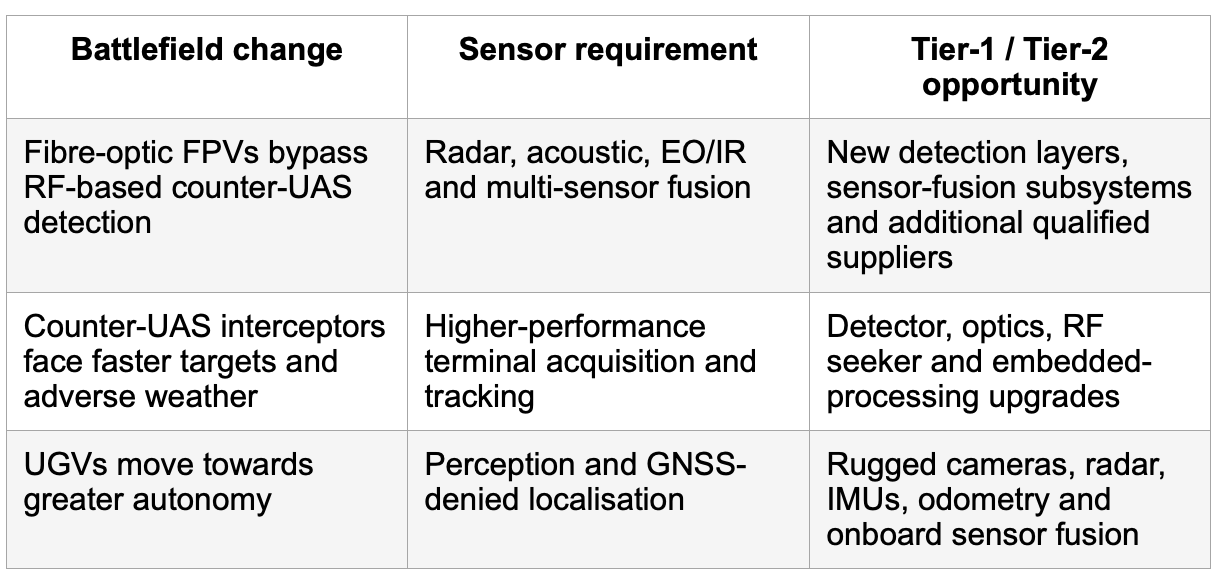
Fibre-optic FPVs are bypassing RF-led detection. Faster interceptors and adverse weather are increasing terminal-sensing requirements. UGV deployment is exposing limitations in perception and GNSS-denied navigation. These are important design-in windows because new operational requirements can reopen component, subsystem and sourcing decisions that would otherwise remain with the incumbent.
Detecting RF-Silent Threats: Fibre-Optic Drones Force Multi-Sensor Architectures
Fibre-optic FPVs are one of the clearest examples of operational change creating new sensor demand. By replacing the radio control link with a physical fibre connection, they remove the emissions on which many counter-UAS and electronic-warfare systems rely for detection and disruption.
NATO's Innovation Challenge on fibre-optic drones sought radar, thermal, optical, acoustic and hybrid technologies capable of detecting and tracking small targets without relying on RF emissions.
This creates design-in routes across several sensor categories. Compact radar can provide active detection independent of the control link, EO/IR can support confirmation and tracking, while acoustic sensing adds a relatively low-cost passive layer.
Ukraine is already showing how these architectures can develop. ZVOOK has built acoustic detectors for FPVs, including fibre-controlled systems, and Ukrainian acoustic technology has subsequently been integrated into Poland's SKYctrl counter-UAS architecture. The Ukrainian-French AURA programme follows the same direction, combining acoustic and optical sensing with edge processing.
RF sensing remains important: emitting threats still need to be detected, classified and geolocated. The change is that RF can no longer provide the complete detection layer against the full threat set. The EU-funded ALTISS programme, for example, combines COMINT-based detection and geolocation with a 360° optical sensor that can automatically be cued towards detected emitters.
For Tier-1 and Tier-2 suppliers, radar, acoustic, EO/IR and RF technologies therefore increasingly occupy complementary positions. The integration requirement also creates opportunities in sensor fusion and edge processing, where integrators must combine inputs, manage false alarms and cue sensors within the system's SWaP-C envelope.
For BD teams, the most relevant targets are counter-UAS integrators with a newly exposed detection gap: those OEMs have a concrete reason to qualify another sensor, introduce an alternative source or redesign part of the detection chain.
Detecting the target is only one side of the counter-UAS sensing requirement. The interceptor itself increasingly needs a more capable sensing stack as target speeds rise and autonomous terminal guidance moves into serially produced systems.
Interceptor Guidance: Faster Targets Raise the Terminal-Sensing Specification
Automatic terminal guidance is already moving into fielded Ukrainian interceptor architectures. MaXon Systems says its combat-tested system automates around 95% of the interception cycle after operator authorisation, while other fielded interceptors combine external radar cueing with onboard day or thermal sensing and automatic terminal tracking. The Octopus interceptor, also equipped with automatic terminal guidance, moved into an 8,000-unit Ukrainian MoD procurement programme in 2026.
In April 2026, Ukraine's Ministry of Defence identified higher-speed interceptors and alternative terminal-guidance solutions that remain effective in adverse weather as priorities. More than 30 companies were already training and validating over 50 AI models for target detection and interception across different weather conditions and times of day.
Jet-powered Shaheds increase the pressure further. Reuters reported speeds of up to around 500 km/h and Ukrainian efforts to scale interceptors in roughly the 370–500 km/h range. That’s why we saw so many Shaheds intercepted above Kyiv, and not in the fields to the north of it. Higher closing speeds reduce the time available for acquisition, classification and trajectory correction, which is critical for the jet-powered Shahed interception.
For image-sensor, infrared-detector, optics and embedded-processing suppliers, that makes acquisition range, detector sensitivity, frame rate, low-light and thermal performance, processing latency and track stability increasingly important design-in parameters.
The TFL Anti-Shahed module shows how directly these parameters affect the engagement envelope. Its reported detection range reaches up to around 1 km under ideal, high-contrast conditions but falls to around 300 metres in difficult weather. That difference leaves materially less time for acquisition, manoeuvre and trajectory correction.
Terminal sensing is also expanding beyond EO/IR. The latest BraveTechEU DefTech Forge includes passive, semi-active and active RF seekers for target detection, tracking and precision guidance.
For suppliers already serving radar, EW or guided-weapon programmes, this creates an adjacent market. The challenge is adapting existing technology to the much tighter SWaP-C and unit-cost requirements of counter-UAS interceptors. As European procurement begins to absorb Ukrainian operational requirements, that route is becoming more direct. Germany's October 2026 agreements with Ukraine included both Hensoldt radar equipment and Quantum Systems jet-drone interceptors, illustrating how counter-UAS requirements proven in Ukraine are moving into European industrial programmes.
UGV Sensors: Perception and Navigation Are the Next Design-In Layer
UGVs show the same pattern at an earlier stage. Ukraine has already moved ground robots into sustained operational use, with more than 22,000 Ukrainian-made systems contracted for 2026, while units conducted more than 16,600 logistics and evacuation missions in June alone.
The platforms are scaling, but perception and navigation still constrain how far they can move from continuous operator control. European deployment remains earlier, but Ukrainian experience is already feeding into product development: ARX Robotics has described how a system developed around European MoD requirements had to be redesigned after gathering the feedback from the military, while Germany has agreed to joint production of the Ukrainian Termit UGV.
Battlefield conditions change the sensor specification. Mud, vegetation, trenches and debris complicate mobility and obstacle detection, while communications and GNSS cannot be assumed to remain available. Remote operators also have limited depth and terrain awareness through onboard cameras.
The requirement is therefore moving from basic teleoperation towards greater onboard perception. Ukrainian manufacturers are already introducing functions such as autonomous control and return after communication loss, but the near-term sensor opportunity is unlikely to resemble a full automotive ADAS stack.
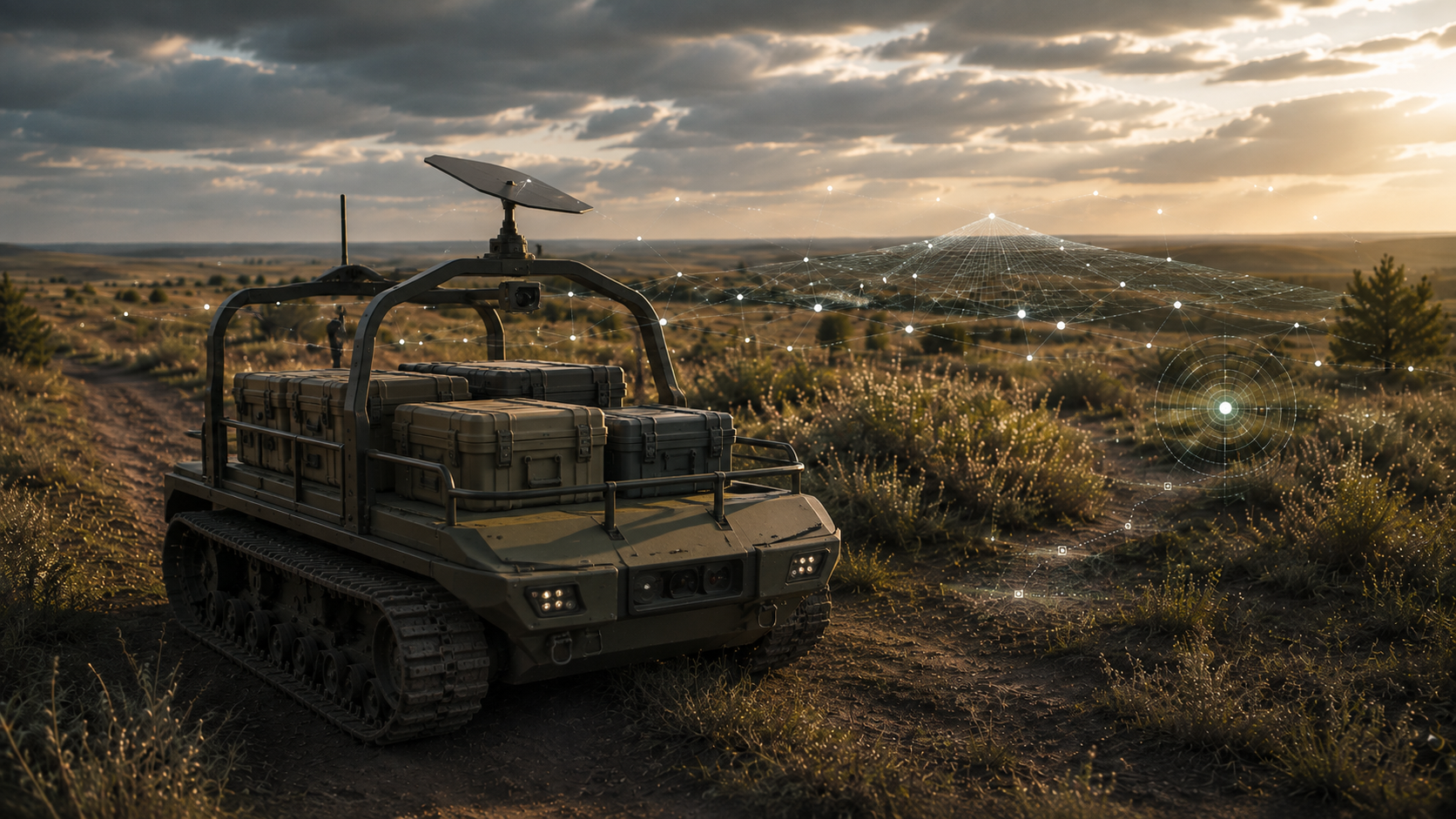
More realistic design-in opportunities sit at component and subsystem level: rugged cameras, radar for obstacle detection, IMUs and odometry for localisation, and embedded processing capable of fusing those inputs onboard.
For automotive, robotics and industrial-sensor suppliers, much of the underlying technology already exists. The challenge is adaptation: ruggedisation, interfaces, environmental qualification, SWaP-C and unit economics. Sensor content will also vary by mission, with logistics, casualty-evacuation and weapon platforms supporting different performance requirements and price points.
GNSS denial adds another layer. The Autumn 2026 EUDIS Defence Hackathon, held under the theme “Autonomy on the Battlefield,” makes GNSS-denied navigation one of two common challenges across all eight participating locations, with autonomous systems expected to rely on onboard sensing and real-time perception.
For inertial-sensor, vision, radar and embedded-processing suppliers, this is broader than a UGV requirement. GNSS-denied localisation is emerging across air, ground and maritime systems, creating potential for common technology blocks and product variants across several platform categories.
Ukraine therefore provides an early view of which subsystem requirements emerge as UGVs move from demonstrations into sustained operational use, and where European OEMs may need to add suppliers, upgrade components or qualify alternative technologies.
Closure
Across counter-UAS, interceptor drones and UGVs, the strongest design-in opportunities appear when operational change forces an OEM to reopen part of the sensing architecture. For Tier-1 and Tier-2 BD and strategy teams, those transition points are often more actionable than platform volume alone because they show where an incumbent position is genuinely contestable.
In Part III, we will look at naval unmanned systems, where sonar, radar, EO/IR and navigation technologies are creating new integration points across USVs and UUVs in mine warfare, ASW, maritime ISR and critical-infrastructure protection.